
Read the label
Compost Bags That Don't Compost

By Alex Jensen
būmi®
Published
Walk down any store aisle and you'll see “compostable,” “biodegradable,” and “eco” printed on bags and packaging. They all sound like the same promise: a better choice for the environment. They're not. Here is what each label actually means, why most compost bags never get the conditions they need to break down, and what a material that truly disappears looks like.
There's plastic in your brain
No, really. A 2025 study by University of New Mexico researchers found that the average brain sample had around seven grams of plastic, roughly equivalent to the weight of a disposable plastic spoon. The amount also jumped about 50% between samples taken in 2016 and 2024.[1],[2]
A spoon's worth of plastic, and rising
≈ 7 g
of plastic in the average brain sample, about the weight of one disposable plastic spoon
Plastic in brain samples, relative to 2016
About 50% more in eight years
So how did it get there? Every year, the world produces over 460 million metric tons of plastic. About 20 million metric tons end up as litter. Plastic never truly goes away. It just breaks down into smaller and smaller pieces called microplastics, particles small enough that they end up in our food, our drinks, our blood, and our heads.[1]

Our current fix, recycling, has not been able to keep up. Only about 9% of all plastic has been recycled. Most countries don’t have the infrastructure to collect, sort, and process plastic, and even the ones that do can’t move fast enough.[1]
Out of every 100 tons of plastic ever made
9%
has been recycled. The rest was landfilled, burned, or left in the environment, where it keeps breaking into smaller pieces.
- 460M+ t
- of plastic produced every year
- ≈ 20M t
- of it ends up as litter in the environment every year
People are looking for better options. Walk down any store aisle and you’ll see labels like “compostable,” “biodegradable,” “eco,” and many more. They all sound like the same promise: a better choice for the environment. They’re not. So what do they actually mean?
What does “compostable” actually mean?
It means a product will break down only under specific conditions and within a specific time frame.[1]
There are two main standards
- Industrial compostable: has to reach 90% breakdown within 6 months inside a heated commercial composting facility. Most people don’t have one nearby, especially in rural communities, and most wouldn’t know how to find one.
- Home compostable: has to reach 90% breakdown within 12 months in a regular backyard pile, with no heat or additives.
The catch with “compostable” is that the promise depends on the right facility, the right pile, and the right person sorting it. Industrial-only items tend to end up in landfills or home compost bins, where they sit and barely break down. The confusion leaves a lot of people tossing everything in the trash. “Compostable” sounds like the solution, but in practice, it rarely delivers.
Read the fine print: real “compostable” bag labels
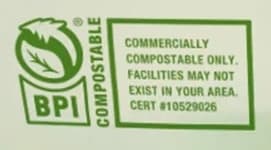
Commercially compostable only. Facilities may not exist in your area.
Certified compostable, and in the same breath, a warning that you probably can't compost it.
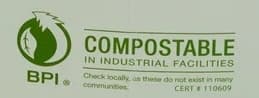
Check locally, as these do not exist in many communities.
Only an industrial facility counts. Your backyard pile doesn't, and neither does the landfill.
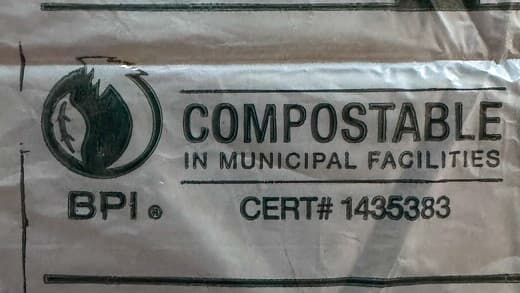
Compostable in municipal facilities.
If your town doesn't run one, this bag goes to the landfill, where it sits and barely breaks down.


Even the home compostable label doesn’t always deliver. In the Big Compost Experiment, a UK study of more than 1,300 pieces of home compostable packaging, about 60% didn’t fully break down. A lot of it stayed largely intact or just split into visible chunks.[1],[2]
Home compostable packaging in real backyard compost
60%
didn't fully break down. Much of it stayed largely intact or just split into visible chunks.
What does “biodegradable” mean?
Biodegradable, as defined by the Cambridge Dictionary, means “able to decay naturally and in a way that is not harmful.” There’s no set timeline and no required conditions. Take wood, for example. It’s 100% biodegradable, but it can take years to break down, so it will never be certified compostable.[1],[2]
Since there’s no clear definition, it’s an easy word for companies to put on a label. The word has become a miscommunication for buyers because sometimes products that use this label do not break down in a way that improves the environment.
Why the labels matter
As our plastic problem grows, people are actively searching for real alternatives. In the Big Compost Experiment, 85% of participants said they were more likely to buy products labeled compostable or biodegradable. The demand is clearly there. The problem is that most products on the market today don’t live up to the label. That’s the gap būmi was built to fill.[1]
The promise
85%
of participants were more likely to buy products labeled compostable or biodegradable
The reality
60%
of home compostable packaging didn't fully break down in their compost
The label decoder: how long until it's gone, and where?
Industrial compostable90% in 6 months
Only inside a heated commercial composting facility, which most people don't have nearby.
Home compostable90% in 12 months
In a regular backyard pile, no heat or additives. In practice, about 60% didn't fully break down.
BiodegradableNo deadline
No set timeline and no required conditions. Wood qualifies, and it can take years.
būmi® blendFully degraded in < 90 days
In regular home compost material, per an independent laboratory study. No microplastics left behind.
Months after it goes in the bin or the pile
The būmi difference
būmi® products are made from a blend of upcycled agricultural biowaste and microbe-edible polymers. The material has the strength, structure, and flexibility people expect from plastic, but that’s where the similarities end.
Soil microbes and fungi break down and “eat” būmi® products, turning them into carbon dioxide, water, and organic matter. The released carbon binds to soil particles and stays stored long-term, improving future plant growth.
- 01
Made from biowaste
Upcycled agricultural biowaste blended with microbe-edible polymers. Strong, structured, and flexible, like plastic.
- 02
Microbes and fungi move in
In everyday soil, compost, or normal field conditions. No heated facility, no special pile.
- 03
They eat it
The material is fully metabolized into carbon dioxide, water, and organic matter.
- 04
Carbon stays in the soil
Released carbon binds to soil particles, stored long-term to feed future plant growth. No microplastics.




Microbes and fungi fully metabolize būmi® products in everyday soil, compost, or normal field conditions. An independent laboratory study showed that the būmi® blend completely degraded in regular home compost material in less than 90 days. The result was healthy soil and no microplastics.
The plastic problem is no longer abstract. It’s in our bodies, it’s in the headlines, and buyers, growers, and regulators are all paying attention. What’s been missing is a material that works like plastic and actually disappears when it’s done.
On the farm, that material is būmigro biodegradable mulch film, which is tilled into the soil after harvest instead of pulled and landfilled. See how it breaks down in the field.
Frequently asked questions
What is the difference between compostable and biodegradable?
Do compostable bags break down in a landfill or a backyard bin?
How much plastic is in the human brain?
How are būmi products different from compostable plastics?
References
- 1.Nihart, A.J. et al. (2025). Bioaccumulation of microplastics in decedent human brains. Nature Medicine, 31, 1114–1119 (brain samples from 2024 carried roughly 50% more micro- and nanoplastic than those from 2016). Link
- 2.University of New Mexico Health Sciences (Feb 2025). UNM Researchers Find Alarmingly High Levels of Microplastics in Human Brains, and Concentrations Are Growing Over Time. Link
- 3.IUCN. Issues Brief: Plastic pollution (May 2024 update) — over 460 million metric tons of plastic are produced every year, and about 20 million metric tons of plastic litter end up in the environment annually. Link
- 4.IUCN (Apr 2018). Earth Day 2018: To end plastic pollution, we need to understand the problem — of the 8,300 million tonnes of plastic produced since the 1950s, only 9% has been recycled. Link
- 5.Biodegradable Products Institute (BPI). Biodegradable vs. Compostable — “compostable” is defined by standards with a set environment and time frame (industrial: ASTM D6400/D6868, 90% breakdown within 6 months in a commercial facility; home: 90% within 12 months at ambient temperature), while “biodegradable” carries no defined time frame or conditions. Link
- 6.Frontiers (Nov 3, 2022). 60% of “home compostable” plastic doesn’t fully break down, ending up in our soil — summary of the UCL Big Compost Experiment citizen-science study. Link
- 7.Purkiss, D., Allison, A.L., Lorencatto, F., Michie, S. & Miodownik, M. (2022). The Big Compost Experiment: Using citizen science to assess the impact and effectiveness of biodegradable and compostable plastics in UK home composting. Frontiers in Sustainability, 3, 942724. Link
- 8.Cambridge Dictionary. Biodegradable: “able to decay naturally and in a way that is not harmful.” Link


